
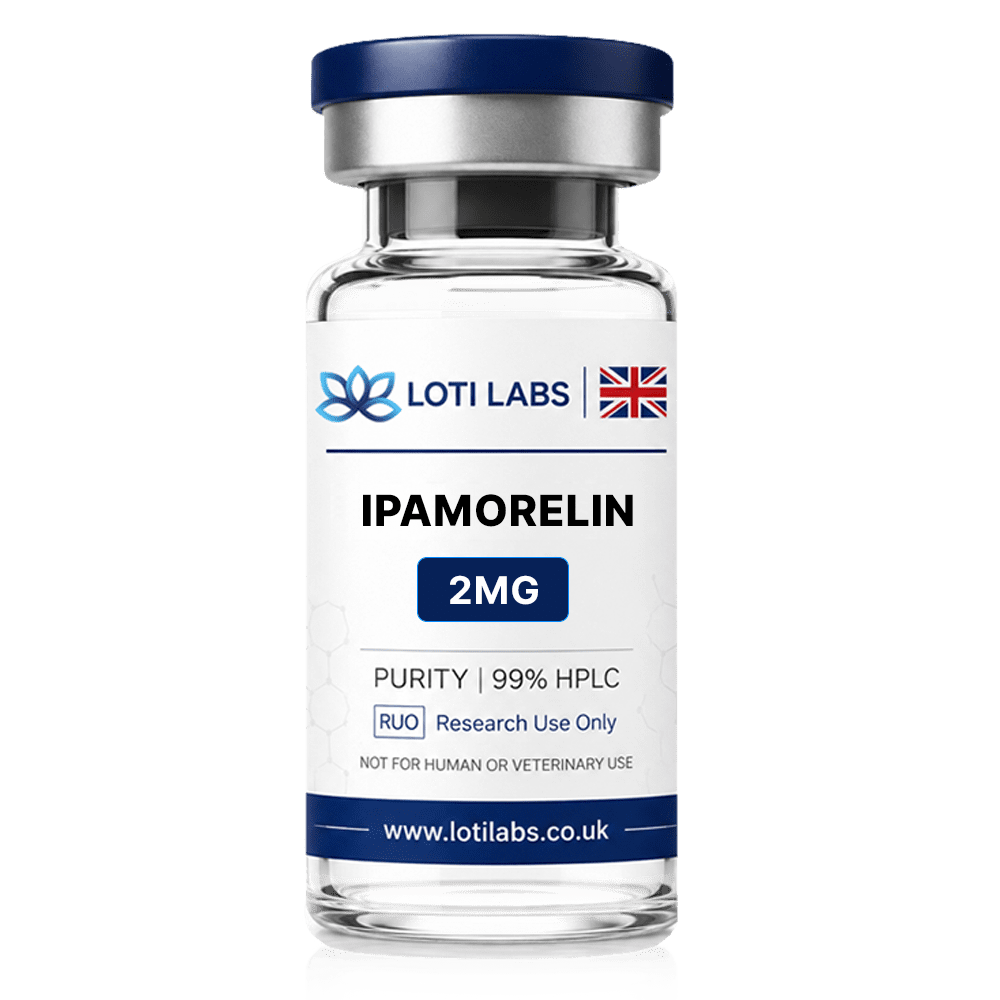
Ipamorelin 2mg
£17.99
- Compound: Ipamorelin 2mg
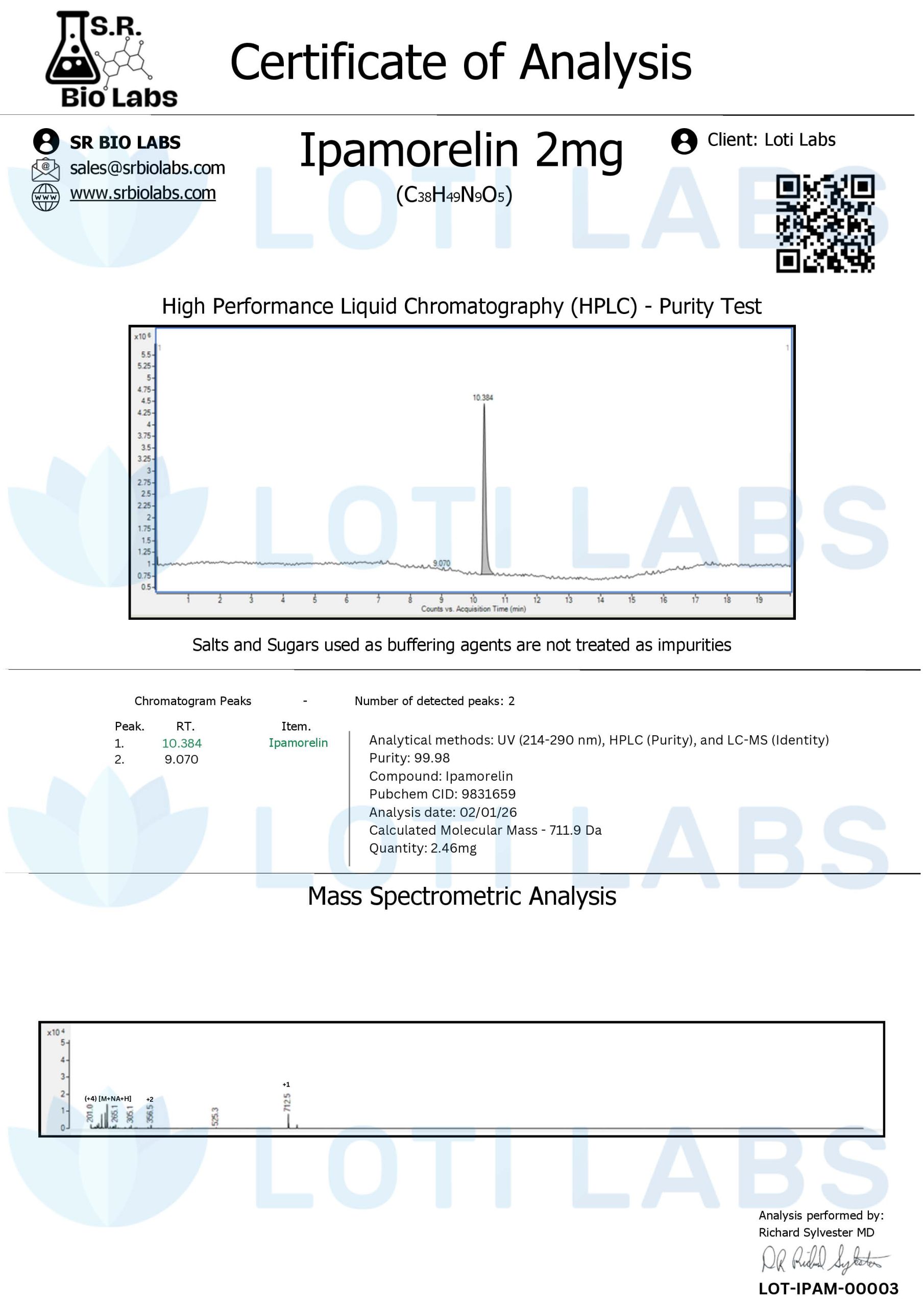
- HPLC Purity: ≥98%
- Quantity: 2mg
- CAS Number: 170851-70-4
- Molecular Formula: C₃₈H₄₉N₉O₅
- Molar Mass: 711.85 g/mol
- Sequence: Aib-His-D-2-Nal-D-Phe-Lys-NH₂
- Appearance: Fine white lyophilised powder
- Storage: Store lyophilised material at −20°C; reconstituted material may be stored at 4°C. Avoid repeated freeze-thaw cycles.
Ipamorelin is a synthetic pentapeptide investigated in in-vitro testing and preclinical research as a selective GHS-R1a agonist and growth hormone secretagogue. Research applications include somatotropic-axis studies, receptor signalling investigations, adipose cell culture studies, metabolic research, and qualified laboratory experimentation.
Buy More, Save More!
| Quantity | Discount | Price | You save |
|---|---|---|---|
| 3, 4 | 3% off | £17.45 | £0.54 |
| 5, 9 | 5% off | £17.09 | £0.90 |
| 10, 14 | 10% off | £16.19 | £1.80 |
| 15, 24 | 15% off | £15.29 | £2.70 |
| 25+ Best value | 20% off | £14.39 | £3.60 |
Buy Ipamorelin 2mg – Loti Labs UK
1. Compound Overview & Technical Specifications
Ipamorelin 2mg is a synthetic pentapeptide investigated extensively in laboratory and preclinical research involving growth hormone secretagogue receptor (GHS-R1a) signalling. The compound is characterised by its sequence Aib-His-D-2-Nal-D-Phe-Lys-NH₂ and is supplied by Loti Labs UK as a fine white lyophilised powder for qualified laboratory research.
Technical Specifications
| Specification | Research Detail |
|---|---|
| Product | Ipamorelin 2mg |
| HPLC Purity | ≥98% |
| Quantity | 2mg |
| Sequence | Aib-His-D-2-Nal-D-Phe-Lys-NH₂ |
| Molecular Formula | C₃₈H₄₉N₉O₅ |
| Molar Mass | 711.85 g/mol |
| CAS Number | 170851-70-4 |
| PubChem CID | 20754357 |
| Appearance | Fine white lyophilised powder |
| Source | Biosynthetic production |
Storage & Laboratory Preparation
- Store lyophilised Ipamorelin at −20°C.
- Protect the material from unnecessary temperature fluctuations.
- For qualified laboratory experimentation, the supplied material may be reconstituted using an appropriate sterile research diluent according to the laboratory’s validated protocol.
- A nominal solubility specification of 100 µg/mL in sterile diluent is provided.
- Reconstituted material can be stored at 4°C according to validated laboratory storage procedures.
- Aliquoting reconstituted material can help minimise repeated freeze-thaw cycles.
- Researchers should independently verify concentration, purity, and stability before experimental use.
2. Mechanism of Action & Research Context
GHS-R1a Receptor Research
Ipamorelin has been investigated as a selective agonist of the growth hormone secretagogue receptor type 1a (GHS-R1a). GHS-R1a signalling is associated with the somatotropic axis and has therefore made ipamorelin a useful research compound for investigating receptor-mediated growth hormone secretagogue activity in controlled preclinical models.
Experimental research has examined how GHS-R1a activation influences intracellular signalling in somatotroph cells, including calcium-dependent processes associated with growth hormone release.
Selectivity Research
A notable research characteristic of ipamorelin is its comparatively selective pharmacological profile. Early research investigated its ability to promote growth hormone release while producing substantially less stimulation of cortisol and prolactin secretion than some earlier growth hormone-releasing peptides.
This selectivity provides a useful experimental model when researchers are examining GHS-R1a signalling, growth hormone secretagogue activity, and hormonal pathway specificity without introducing unnecessary pathway stimulation into the experimental design.
Somatotropic-Axis Studies
Ipamorelin has been investigated in preclinical studies examining the interaction between GHS-R1a signalling and the hypothalamic-pituitary growth hormone axis. Researchers may use such models to investigate:
- Growth hormone secretagogue receptor activity
- Pulsatile growth hormone signalling
- Somatotroph-cell responses
- Receptor selectivity
- Intracellular calcium signalling
- Interactions between GHS and GHRH pathways
- Comparative pharmacology of growth hormone secretagogues
Comparative Research
Ipamorelin has been compared experimentally with other growth hormone secretagogues, including GHRP-2, GHRP-6 and hexarelin, particularly when assessing receptor selectivity and hormonal signalling profiles.
Research designs may also examine interactions between GHS-R1a agonists and GHRH-related compounds. These experiments are useful for investigating how different signalling pathways converge on growth hormone secretion and somatotroph activity.
Gastrointestinal Research
GHS-R1a-related signalling has also been investigated in gastrointestinal research models. Experimental work has explored the relationship between growth hormone secretagogue pathways, enteric signalling and gastrointestinal motility.
These studies can provide additional research context for investigating receptor distribution and signalling outside the pituitary system.
Cell & Molecular Research Applications
For in-vitro testing, Ipamorelin can be incorporated into controlled receptor, signalling and cell-response experiments. Research applications may include adipose cell culture studies, pathway mapping, receptor-binding investigations and broader metabolic-signalling research.
All experimental concentrations, exposure conditions and analytical endpoints should be established independently by qualified laboratory personnel.
3. Literature & Citation Index
Selected literature associated with Ipamorelin research includes:
- Raun K, et al. “Ipamorelin, the first selective growth hormone secretagogue.” European Journal of Endocrinology. 1998;139(5):552–561.
- Johansen PB, et al. “Ipamorelin, a new growth-hormone-releasing peptide, induces longitudinal bone growth in rats.” Growth Hormone & IGF Research. 1999;9(2):106–113.
- Beck Jensen JE, et al. “Growth hormone secretagogues: implications for clinical practice.” Hormone Research. 1997;48(Suppl 6):9–14.
- Trudel L, et al. “Ghrelin/motilin-related peptide is a potent prokinetic agent in healthy human subjects.” American Journal of Physiology – Gastrointestinal and Liver Physiology. 2002;282(4):G655–G660.
Research identifiers:
- CAS: 170851-70-4
- PubChem: CID 20754357
4. Laboratory Terms & Compliance
Laboratory Research Use Only.
Ipamorelin 2mg supplied by Loti Labs UK is intended exclusively for qualified laboratory research, in-vitro testing, preclinical research, adipose cell culture studies, and qualified laboratory experimentation. It is not supplied as a food, dietary supplement, cosmetic ingredient, medicinal product, or therapeutic preparation.
This material is not intended for human or veterinary administration. It must not be used for diagnosis, treatment, prevention or mitigation of disease, or for any other clinical or therapeutic purpose.
Laboratory personnel are responsible for appropriate handling, storage, analytical verification, risk assessment and compliance with all applicable UK/EU laboratory requirements. No claims are made regarding suitability for human use or therapeutic efficacy.
For research/laboratory use only. No other uses are permitted.
| Weight |
0.03125 lbs |
|---|---|
| Appearance |
Fine White Lyophilized Powder |
| Residue Sequence |
Aib-His-D-2-Nal-D-Phe-Lys-NH2 |
| Solubility |
100 µg/mL sterile diluent (distilled de-ionized water) |
| Source |
Biosynthetic production |
| Stability |
Lyophilized protein is to be stored at -20°C. It is recommended to divide the remaining reconstituted peptide into multiple vials so as to avoid a cycle of freezing and thawing. Reconstituted protein can be stored at 4°C. |
| Molar Mass |
711.85 g/mol |
| CAS Number |
170851-70-4 |
| PubChem |
CID 20754357 |
| Molecular Formula |
C38H49N9O5 |
| Terms |
This product is sold for research/laboratory usage only. No other uses are permited. |
You must be logged in to post a review.
Related products

Reviews
There are no reviews yet.