
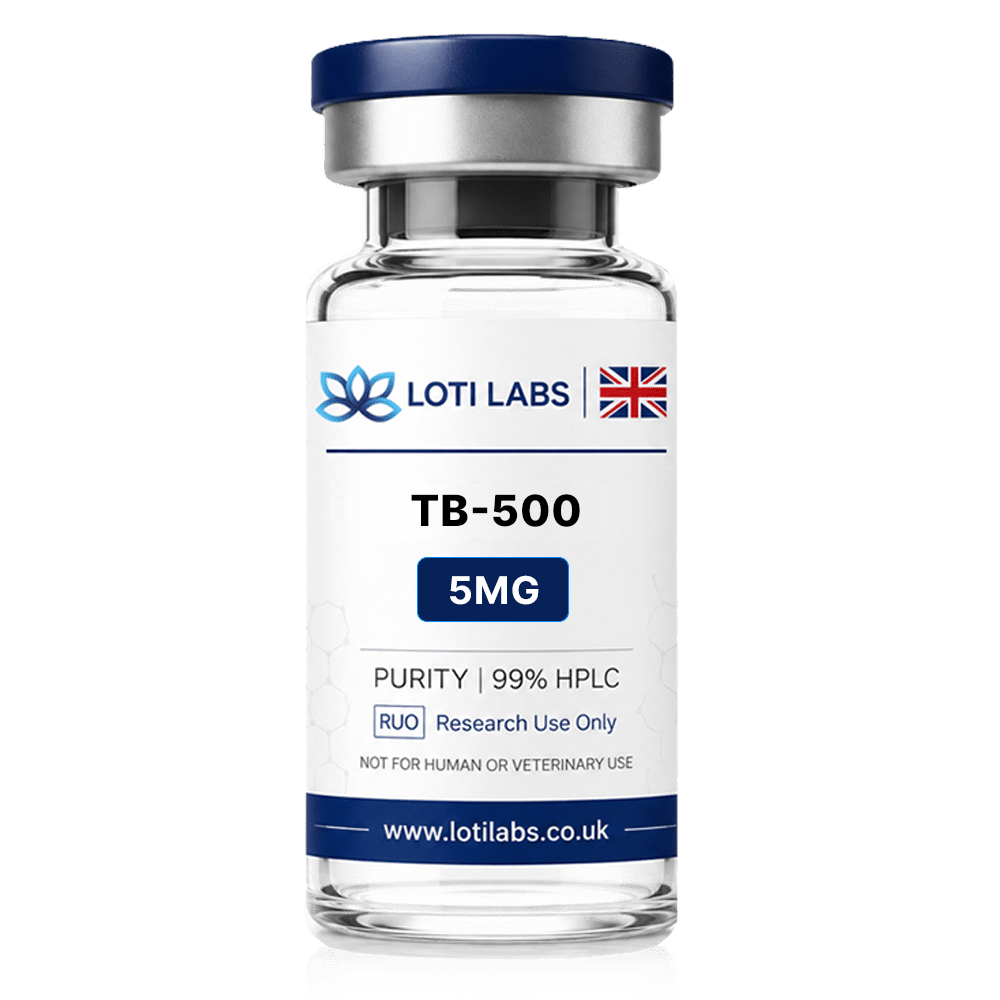
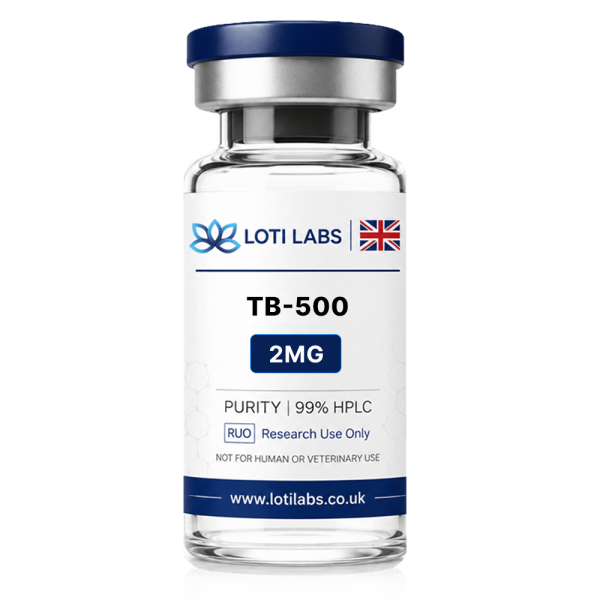
Buy Thymosin Beta 4 (TB-500) 5mg
£34.99
- Compound: Thymosin Beta 4 (TB-500) 5mg
- Quantity: 5mg
- Peptide Length: 43 amino acids
- Sequence: Ac-Ser-Asp-Lys-Pro-Asp-Met-Ala-Glu-Ile-Glu-Lys-Phe-Asp-Lys-Ser-Lys-Leu-Lys-Lys-Thr-Glu-Thr-Gln-Glu-Lys-Asn-Pro-Leu-Pro-Ser-Lys-Glu-Thr-Ile-Glu-Gln-Glu-Lys-Gln-Ala-Gly-Glu-Ser
- Molecular Formula: C₂₁₂H₃₅₀N₅₆O₇₈S
- Molar Mass: 4963.44 g/mol
- CAS Number: 77591-33-4
- PubChem: CID 16132341
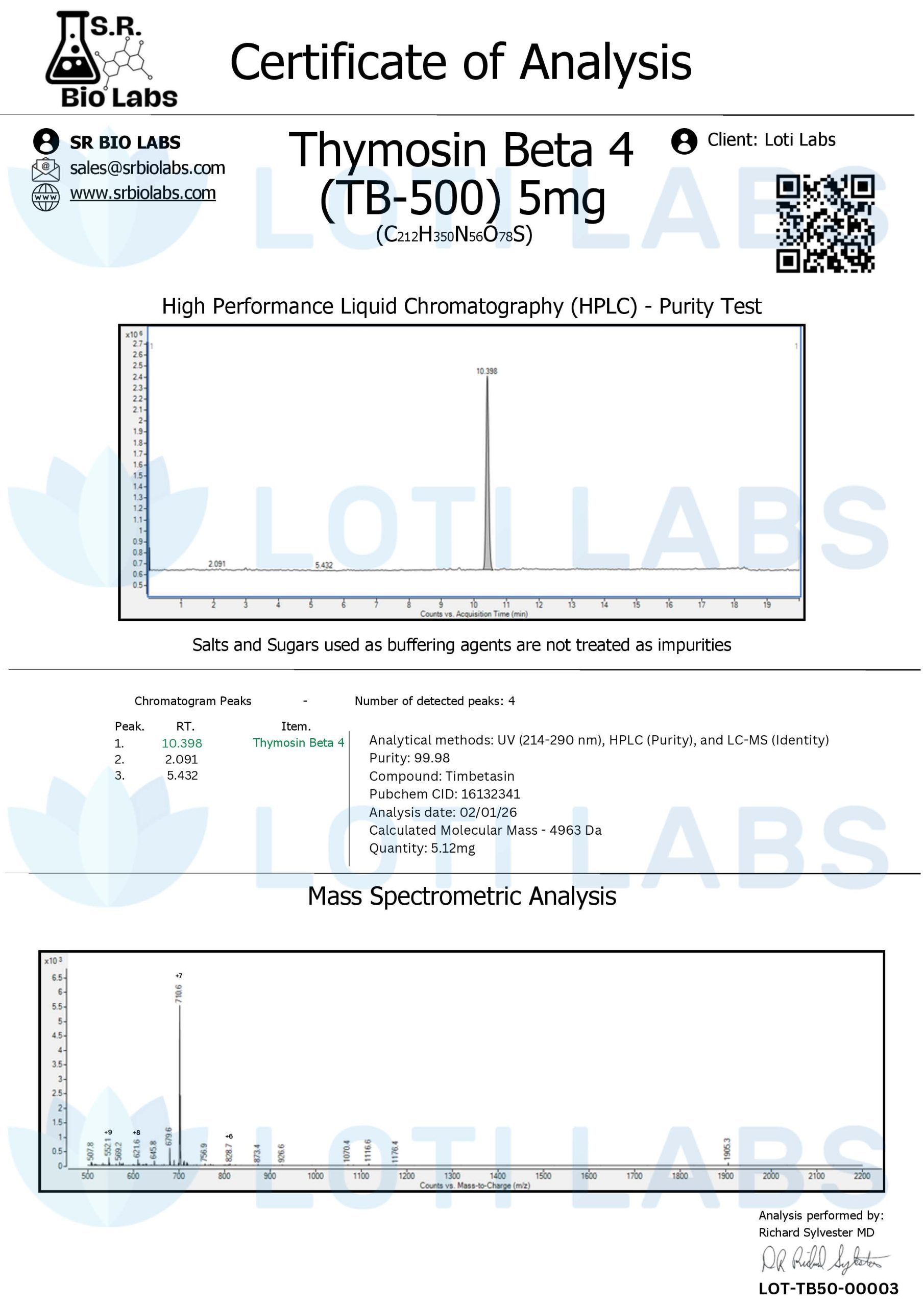
- HPLC Purity: >98%
- Appearance: Lyophilised powder
- Source: Biosynthetic production
- Storage: Lyophilised material at −20°C; reconstituted material at 4°C
- Solubility: 100 µg/mL sterile diluent
- Research Focus: Actin dynamics, cellular migration, tissue-remodelling pathways, angiogenesis and inflammatory signalling
Thymosin Beta 4 is a naturally occurring 43-amino-acid peptide extensively investigated for its interaction with G-actin and cytoskeletal signalling. TB-500 5mg is supplied as a research compound for in-vitro testing, preclinical research, cell culture studies and qualified laboratory experimentation only.
Buy More, Save More!
| Quantity | Discount | Price | You save |
|---|---|---|---|
| 3, 4 | 3% off | £33.94 | £1.05 |
| 5, 9 | 5% off | £33.24 | £1.75 |
| 10, 14 | 10% off | £31.49 | £3.50 |
| 15, 24 | 15% off | £29.74 | £5.25 |
| 25+ Best value | 20% off | £27.99 | £7.00 |
Buy Thymosin Beta 4 (TB-500) 5mg – Loti Labs UK
Compound Overview & Technical Specifications
Thymosin Beta 4 (Tβ4), commonly referred to as TB-500 in research and commercial contexts, is a 43-amino-acid peptide associated with actin regulation and cellular motility. It has been extensively investigated in preclinical models examining cytoskeletal organisation, cellular migration, angiogenesis, tissue-remodelling processes and inflammatory signalling.
Tβ4 is widely distributed across mammalian tissues and is particularly notable for its ability to bind G-actin monomers, making actin dynamics a central focus of laboratory research involving this peptide.
Technical Specifications
- Product: Thymosin Beta 4 (TB-500) 5mg
- Quantity: 5mg
- Peptide Length: 43 amino acids
- Sequence: Ac-Ser-Asp-Lys-Pro-Asp-Met-Ala-Glu-Ile-Glu-Lys-Phe-Asp-Lys-Ser-Lys-Leu-Lys-Lys-Thr-Glu-Thr-Gln-Glu-Lys-Asn-Pro-Leu-Pro-Ser-Lys-Glu-Thr-Ile-Glu-Gln-Glu-Lys-Gln-Ala-Gly-Glu-Ser
- Molecular Formula: C₂₁₂H₃₅₀N₅₆O₇₈S
- Molar Mass: 4963.44 g/mol
- CAS Number: 77591-33-4
- PubChem: CID 16132341
- HPLC Purity: >98% according to the supplied product information
- Source: Biosynthetic production
- Appearance: Lyophilised powder
- Solubility: 100 µg/mL in sterile diluent
Mechanism of Action & Research Context
G-Actin Binding & Cytoskeletal Research
One of the defining features of Tβ4 research is its interaction with G-actin, the monomeric form of actin.
The peptide contains the well-characterised LKKTET actin-binding motif. By interacting with actin monomers, Tβ4 has been investigated as a regulator of the balance between soluble G-actin and polymerised filamentous actin.
This makes it particularly relevant to research involving:
- Cytoskeletal organisation
- Cellular migration
- Cell motility
- Actin polymerisation
- Cell morphology
- Tissue remodelling
Actin dynamics are fundamental to cellular movement, making Tβ4 a useful experimental compound for studying how cells respond to mechanical and biochemical signals.
Cellular Migration Research
Tβ4 has been investigated in experimental models involving cellular migration and movement.
Changes in actin organisation influence processes such as cell spreading, migration and cytoskeletal reorganisation. Research into these mechanisms has helped establish Tβ4 as an important model for studying how actin-regulating peptides affect cellular behaviour.
Angiogenesis Research
Preclinical research has also examined Tβ4 in experimental angiogenesis models.
Studies have investigated signalling associated with endothelial cell migration and vascular development, providing researchers with an experimental framework for examining the molecular relationship between cell migration, cytoskeletal dynamics and vascular signalling.
Inflammatory Signalling
Tβ4 has been investigated in relation to inflammatory signalling pathways, including NF-κB-associated pathways.
Experimental studies have examined changes in inflammatory mediators and cytokine signalling under different cellular conditions. This makes Tβ4 relevant to laboratory research exploring the transition between inflammatory responses and tissue-remodelling processes.
Tissue-Response & Remodelling Research
Tβ4 has been extensively studied in preclinical tissue-response models, particularly those examining cellular migration, extracellular matrix interactions and tissue remodelling.
Research has included experimental models involving:
- Dermal tissue
- Skeletal muscle
- Cardiovascular tissue
- Neural tissue
- Oligodendrocyte biology
- Angiogenic pathways
The diversity of these models reflects the peptide’s broad involvement in cellular and cytoskeletal signalling.
Ac-SDKP & Related Peptide Research
Tβ4 research also intersects with studies of Ac-SDKP, a tetrapeptide associated with proteolytic processing of thymosin beta 4.
Ac-SDKP has been investigated independently in experimental models involving angiogenesis and tissue-remodelling pathways. Researchers should distinguish the activity of Ac-SDKP from the activity of intact Tβ4 when interpreting experimental results.
Neural & Myelination Research
Preclinical research has investigated Tβ4 in neural models, including studies involving oligodendrocyte differentiation and myelination.
These experiments provide a research framework for examining relationships between peptide signalling, cellular differentiation and neural tissue responses.
The underlying mechanisms remain an active area of investigation, with experimental work examining whether observed responses are mediated directly through cellular signalling or indirectly through changes in inflammatory and tissue environments.
Comparative Research
Tβ4 can be incorporated into comparative laboratory studies alongside other peptides investigated in tissue-response models.
BPC-157 provides a different experimental model involving cellular signalling and angiogenesis, while MGF (Mechano Growth Factor) is studied in relation to IGF-1-related signalling and muscle-cell biology.
Comparing these compounds can help researchers examine how distinct molecular mechanisms influence cellular migration, tissue-response pathways and cytoskeletal activity.
Laboratory Handling & Storage
Thymosin Beta 4 (TB-500) 5mg is supplied as a lyophilised powder.
The supplied specifications recommend:
- Store lyophilised material at −20°C.
- Reconstituted material can be stored at 4°C.
- Aliquot reconstituted material where appropriate to minimise repeated freeze-thaw cycles.
- Protect the peptide from unnecessary exposure to heat, moisture and environmental stress.
- The stated solubility is 100 µg/mL in sterile diluent.
- Researchers should establish final concentrations and preparation conditions according to their validated experimental protocol.
- Appropriate analytical methods, including HPLC and mass spectrometry where applicable, can be used to verify material identity and purity.
Literature & Citation Index
The following scientific references were supplied with the product information:
- Goldstein AL, Hannappel E, Kleinman HK. (2005). Thymosin β4: actin-sequestering protein moonlights to repair injured tissues. Trends in Molecular Medicine. 11(9):421–429.
- Bock-Marquette I, et al. (2004). Thymosin β4 activates integrin-linked kinase and promotes cardiac cell migration, survival and cardiac repair. Nature. 432(7016):466–472.
- Sosne G, et al. (2002). Thymosin beta 4 inhibits NF-kappaB activation in corneal epithelial cells. Journal of Biological Chemistry. 277(31):28177–28185.
- Tan J, et al. (2011). Thymosin beta-4 promotes oligodendrocyte differentiation and myelination in neonatal rat brain. Journal of Neurochemistry. 116(5):759–768.
Laboratory Terms & Compliance
LABORATORY RESEARCH USE ONLY
Thymosin Beta 4 (TB-500) 5mg is supplied strictly for qualified laboratory research, in-vitro testing, preclinical research, cell culture studies and scientific experimentation.
This product is not intended for human or veterinary administration, consumption, diagnosis, treatment, prevention of disease, cosmetic use, therapeutic use, athletic performance or any other application outside qualified laboratory research.
Purchasers and researchers are responsible for ensuring that all handling, storage, testing and disposal procedures are conducted by appropriately qualified personnel and in accordance with applicable UK/EU legislation, institutional procedures and laboratory safety requirements.
No other uses are permitted.
| Peptide Sequence |
Ac-Ser-Asp-Lys-Pro-Asp-Met-Ala-Glu-Ile-Glu-Lys-Phe-Asp-Lys-Ser-Lys-Leu-Lys-Lys-Thr-Glu-Thr-Gln-Glu-Lys-Asn-Pro-Leu-Pro-Ser-Lys-Glu-Thr-Ile-Glu-Gln-Glu-Lys-Gln-Ala-Gly-Glu-Ser |
|---|---|
| Source |
Biosynthetic production |
| CAS Number |
77591-33-4 |
| PubChem |
CID 16132341 |
| Molecular Formula |
C212H350N56O78S |
You must be logged in to post a review.
Related products

Reviews
There are no reviews yet.