
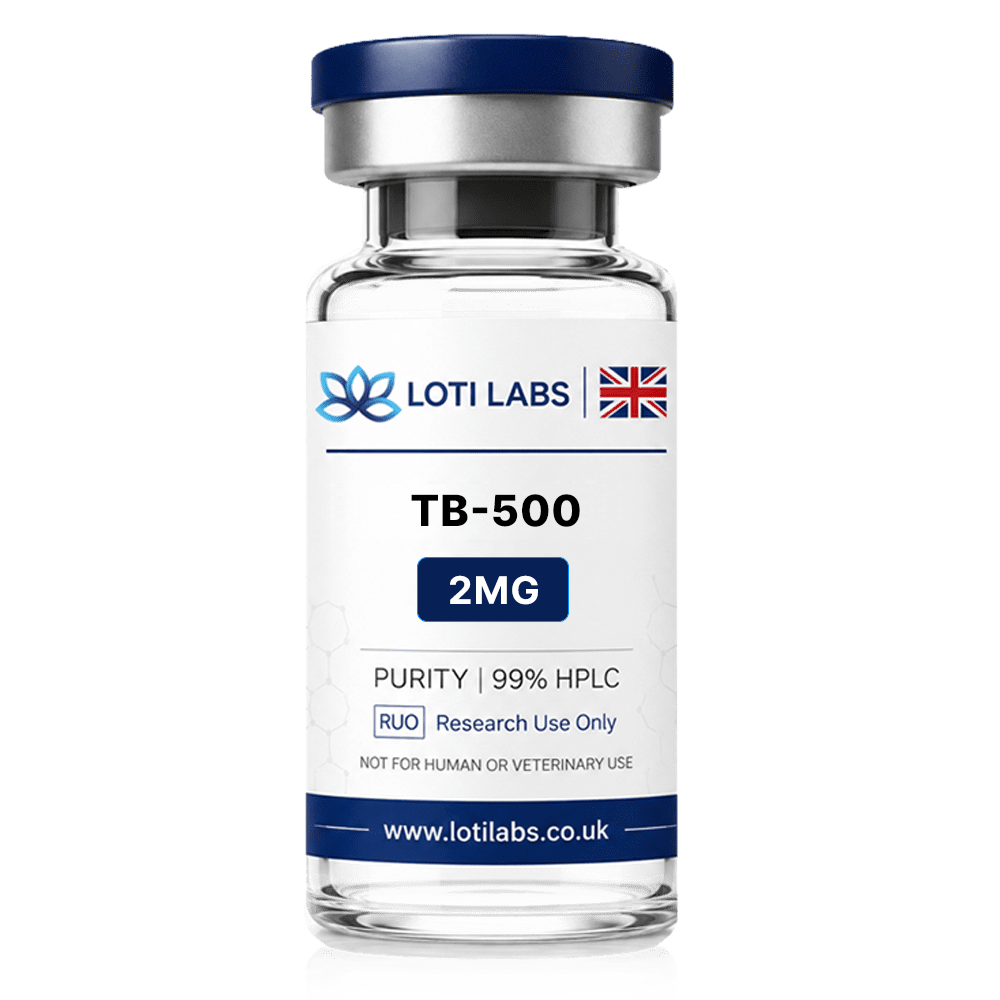
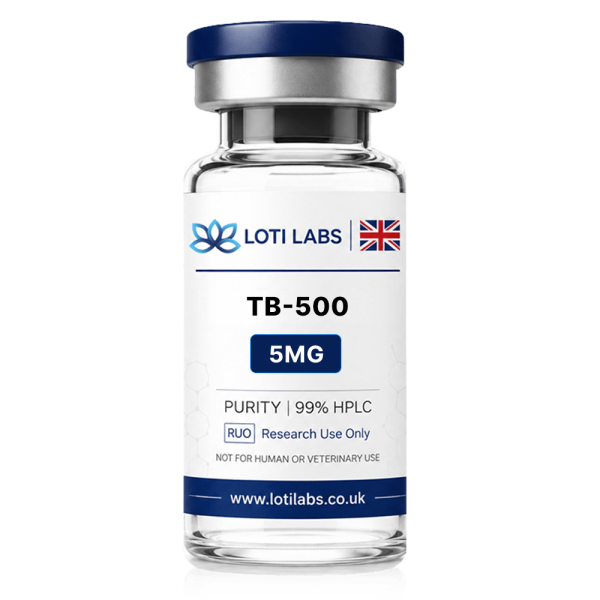
Buy Thymosin Beta 4 (TB-500) 2mg
£20.99
- HPLC Purity: ≥98%
- Quantity: 2mg
- CAS Number: 77591-33-4
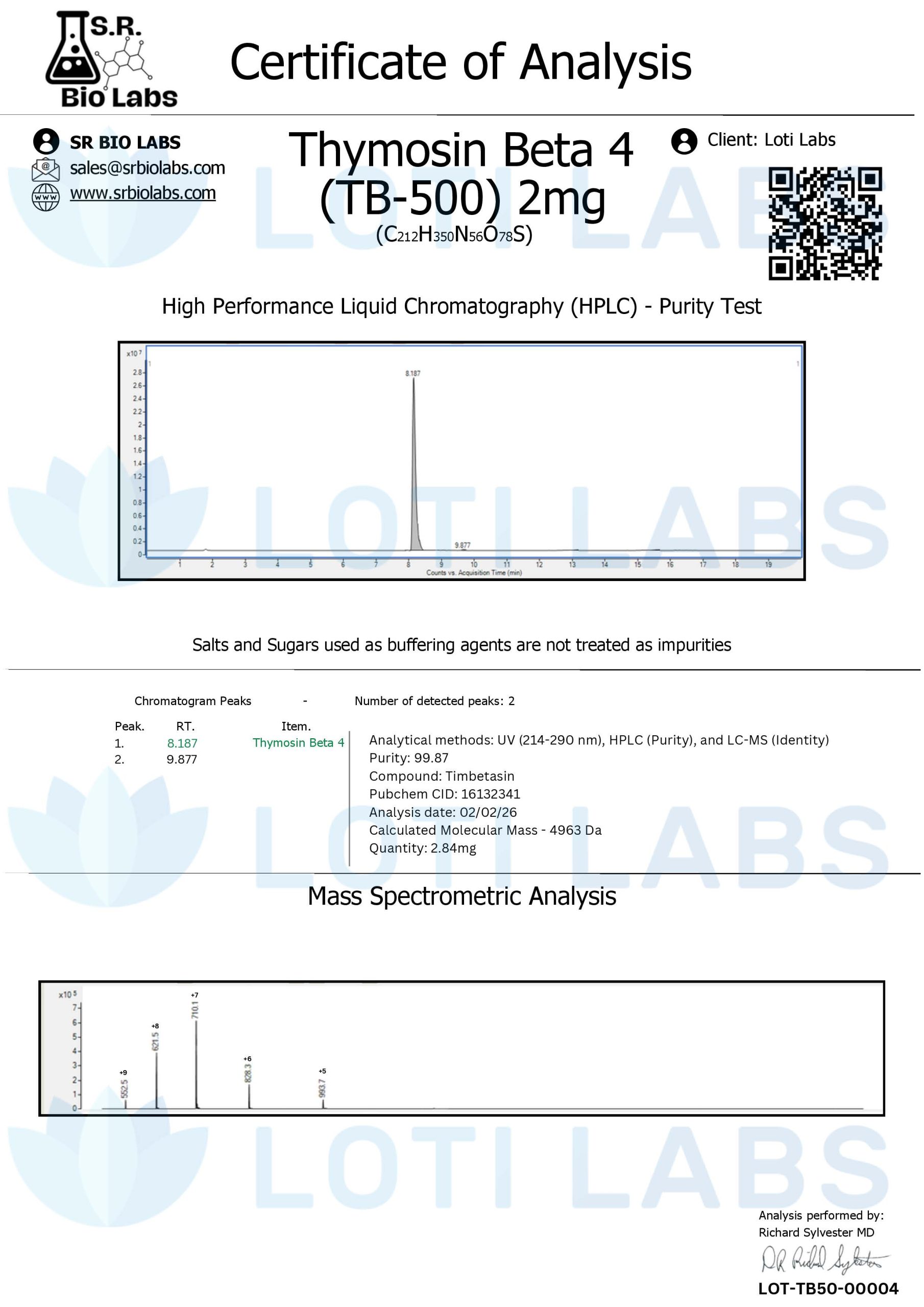
- Molecular Mass: 4963.44 g/mol
- Molecular Formula: C212H350N56O78S
- Appearance: Lyophilised powder
- Source: Biosynthetic production
- Solubility: 100 µg/mL sterile diluent
- Storage: Store lyophilised material at −20°C. Reconstituted material may be stored at 4°C according to appropriate laboratory protocols.
- Peptide: 43-amino-acid Thymosin Beta 4 sequence
Thymosin Beta 4 (TB-500) is a research peptide investigated in in-vitro testing and preclinical research for its relationship with actin sequestration, cellular motility, angiogenic signalling and cytoskeletal organisation. The 2mg format provides a research-scale quantity for qualified laboratory experimentation, including controlled cell-culture and adipose cell culture studies.
Buy More, Save More!
| Quantity | Discount | Price | You save |
|---|---|---|---|
| 3, 4 | 3% off | £20.36 | £0.63 |
| 5, 9 | 5% off | £19.94 | £1.05 |
| 10, 14 | 10% off | £18.89 | £2.10 |
| 15, 24 | 15% off | £17.84 | £3.15 |
| 25+ Best value | 20% off | £16.79 | £4.20 |
Buy Thymosin Beta 4 (TB-500) 2mg – Loti Labs UK
1. Compound Overview & Technical Specifications
Thymosin Beta 4 (Tβ4), commonly referenced as TB-500 in research literature and commercial research settings, is a 43-amino-acid peptide extensively investigated for its interaction with G-actin and its relationship with cellular motility and cytoskeletal dynamics.
Research into Tβ4 has examined multiple biological pathways, including actin regulation, integrin-linked kinase signalling, cellular migration and angiogenesis. This 2mg research-grade preparation is supplied as a lyophilised powder for qualified laboratory experimentation.
Quick Research Specifications
- Product: Thymosin Beta 4 (TB-500) 2mg
- HPLC Purity: ≥98%
- Quantity: 2mg
- CAS Number: 77591-33-4
- Molecular Formula: C212H350N56O78S
- Molecular Mass: 4963.44 g/mol
- Peptide Length: 43 amino acids
- Appearance: Lyophilised powder
- Source: Biosynthetic production
- Reported Solubility: 100 µg/mL sterile diluent
Storage & Laboratory Handling
- Store the lyophilised material at −20°C.
- Reconstitute using an appropriate sterile laboratory diluent according to the validated research protocol.
- Aliquoting reconstituted material can minimise repeated freeze-thaw cycles.
- Reconstituted material may be stored at 4°C where supported by the laboratory’s validated storage conditions.
- Appropriate aseptic handling and laboratory safety procedures should be followed throughout preparation and experimentation.
2. Mechanism of Action & Research Context
G-Actin Sequestration
One of the principal research interests surrounding Thymosin Beta 4 is its interaction with G-actin monomers.
Tβ4 binds available actin monomers and influences the balance between actin polymerisation and depolymerisation. Because actin dynamics are closely associated with cellular movement and cytoskeletal organisation, this mechanism provides an important experimental framework for investigating cellular motility.
In-vitro research can use this mechanism to investigate cytoskeletal rearrangement, cell migration and related cellular responses under controlled laboratory conditions.
Integrin-Linked Kinase Signalling
Preclinical research has also investigated the relationship between Tβ4 and integrin-linked kinase (ILK) signalling.
ILK is associated with cellular adhesion, migration and survival pathways. Research examining Tβ4 and ILK provides an additional mechanism for studying how peptide signalling may influence cellular behaviour in experimental models.
Cellular Migration & Tissue-Remodelling Research
Tβ4 has been widely investigated in experimental models involving cellular migration and tissue remodelling.
Its relationship with actin organisation provides a mechanistic basis for examining how cells respond to environmental signals requiring changes in morphology and movement. These properties have contributed to research involving wound-closure models, endothelial-cell migration and other controlled cell-culture systems.
Angiogenesis Research
Angiogenesis, the formation of new blood vessels from existing vasculature, represents another significant area of Tβ4 research.
Preclinical studies have examined Tβ4 in relation to endothelial-cell migration and vascular organisation. Research has also investigated potential interactions with signalling molecules such as vascular endothelial growth factor (VEGF).
These experimental findings provide a research framework for laboratory studies examining endothelial behaviour, vascular signalling and angiogenic processes.
Inflammatory Signalling
Research has investigated Tβ4 in several experimental models involving inflammatory signalling.
Rather than being considered solely through the lens of inflammatory suppression, laboratory studies have examined how Tβ4 may interact with cellular signalling during different phases of experimental tissue-remodelling models.
This provides opportunities for qualified researchers to investigate relationships between inflammatory pathways, cellular migration and cytoskeletal dynamics.
Neural Research Context
Preclinical research has also examined Tβ4 in experimental neurological models, including studies involving neuronal migration, glial responses and axonal remodelling.
These investigations provide a research context for studying cellular responses within controlled neural and CNS-related laboratory models. Further research is required to characterise the underlying mechanisms and their relevance across different experimental systems.
Comparative Research Context
Tβ4’s primary experimental distinction is its association with actin sequestration and cytoskeletal regulation. This makes it mechanistically different from research compounds primarily investigated through growth-factor or receptor-mediated pathways.
For laboratory researchers, the 2mg format can provide a suitable research-scale quantity for controlled in-vitro experiments, analytical work and concentration-response investigations.
Different quantities of the same research compound may be selected according to experimental design, sample requirements and laboratory workflow.
3. Literature & Citation Index
- Goldstein AL, Hannappel E, Kleinman HK. (2005). Thymosin β4: actin-sequestering protein moonlights to repair injured tissues. Trends in Molecular Medicine, 11(9), 421–429. PMID: 16099722
- Smart N, et al. (2007). Thymosin beta4 induces adult epicardial progenitor mobilization and neovascularization. Nature, 445(7124), 177–182. PMID: 17108969
- Huff T, Müller CS, Otto AM, Netzker R, Hannappel E. (2001). Beta-thymosins, small acidic peptides with multiple functions. International Journal of Biochemistry & Cell Biology, 33(3), 205–220. PMID: 11311854
- Bock-Marquette I, et al. (2004). Thymosin beta4 activates integrin-linked kinase and promotes cardiac cell migration, survival and cardiac repair. Nature, 432(7016), 466–472. PMID: 15565145
- Sosne G, Qiu P, Goldstein AL, Wheater M. (2010). Biological activities of thymosin beta4 defined by active sites in short peptide sequences. FASEB Journal, 24(7), 2144–2151. PMID: 20181939
4. Laboratory Terms & Compliance
Laboratory Research Use Only.
Thymosin Beta 4 (TB-500) 2mg is supplied exclusively as a research-grade compound for qualified laboratory experimentation, in-vitro testing and preclinical research. It may be investigated in controlled laboratory models, including cell-culture systems and adipose cell culture studies.
This product is not intended for human or veterinary consumption or administration and is not supplied as a medicine, dietary supplement, food product or cosmetic ingredient. No claims are made regarding the diagnosis, treatment, prevention or cure of any disease or medical condition.
Researchers and laboratory professionals are responsible for ensuring that all handling, storage, experimentation and disposal procedures comply with applicable UK and European legislation, institutional requirements and laboratory safety protocols.
This product is sold for research/laboratory usage only. No other uses are permitted.
| Purity |
≥99% |
|---|---|
| Form |
Lyophilised vial |
| COA Tested |
Third-party |
You must be logged in to post a review.
Related products

Reviews
There are no reviews yet.