
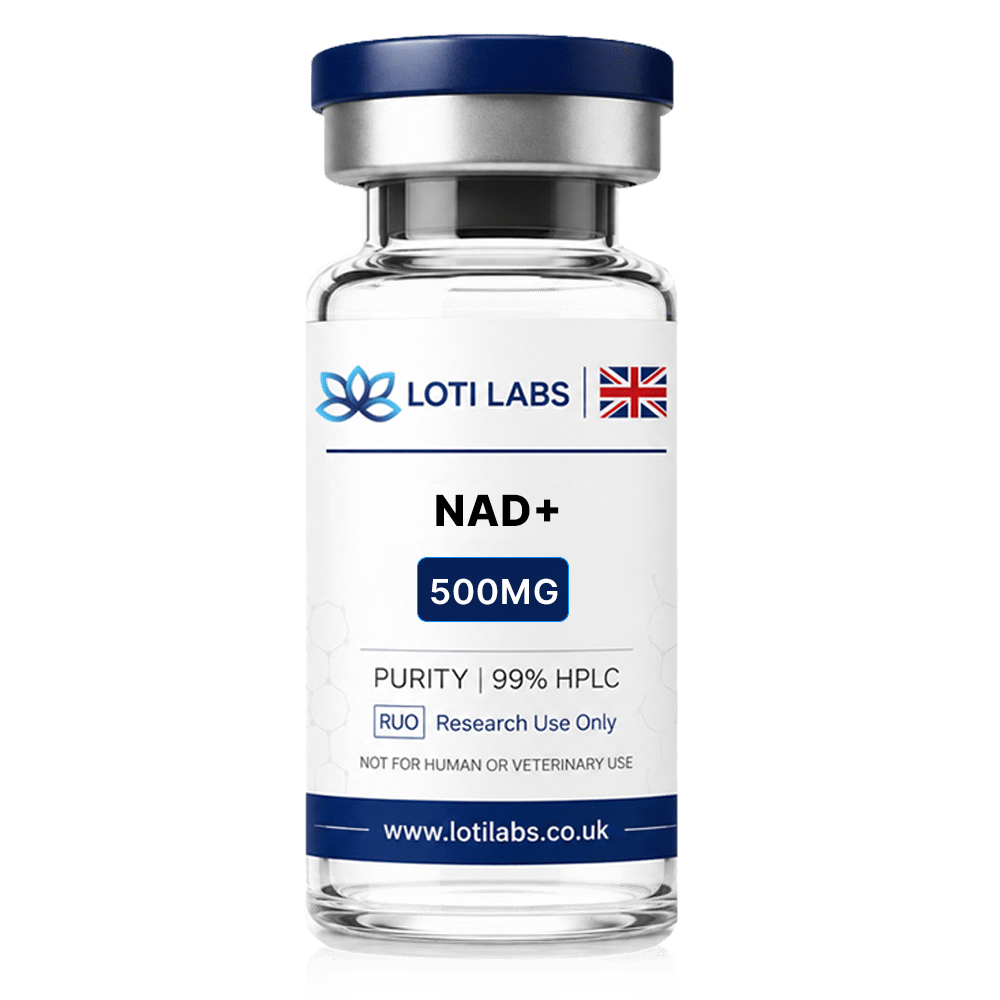
Buy NAD+ 500mg
£69.99
- Compound: NAD+ 500mg
- Quantity: 500mg
- Chemical Name: Nicotinamide adenine dinucleotide
- Form: Lyophilised powder
- HPLC Purity: Not specified in the supplied product data
- Storage: −20°C, protected from light and moisture
- Solubility: Highly water-soluble
- Research Focus: NAD+ metabolism, mitochondrial function, redox biology and NAD+-dependent enzyme pathways
NAD+ 500mg is a high-concentration research compound investigated as a central coenzyme in cellular redox reactions, energy metabolism and NAD+-dependent signalling. It is supplied as a lyophilised compound for in-vitro testing, preclinical research, adipose cell culture studies and qualified laboratory experimentation only.
Buy More, Save More!
| Quantity | Discount | Price | You save |
|---|---|---|---|
| 3, 4 | 3% off | £67.89 | £2.10 |
| 5, 9 | 5% off | £66.49 | £3.50 |
| 10, 14 | 10% off | £62.99 | £7.00 |
| 15, 24 | 15% off | £59.49 | £10.50 |
| 25+ Best value | 20% off | £55.99 | £14.00 |
Buy NAD+ 500mg – Loti Labs UK
Compound Overview & Technical Specifications
NAD+ 500mg is a high-concentration formulation of nicotinamide adenine dinucleotide (NAD+), an essential cellular coenzyme involved in redox reactions and a wide range of metabolic and signalling processes.
NAD+ exists in an oxidised/reduced redox pair with NADH and is extensively investigated in cellular energy metabolism, mitochondrial biology, DNA repair and NAD+-dependent enzyme activity. Its involvement across multiple cellular pathways makes NAD+ an important research compound for in-vitro testing and preclinical laboratory investigation.
Technical Specifications
- Product: NAD+ 500mg
- Quantity: 500mg
- Compound: Nicotinamide adenine dinucleotide
- Abbreviation: NAD+
- Physical Form: Lyophilised powder
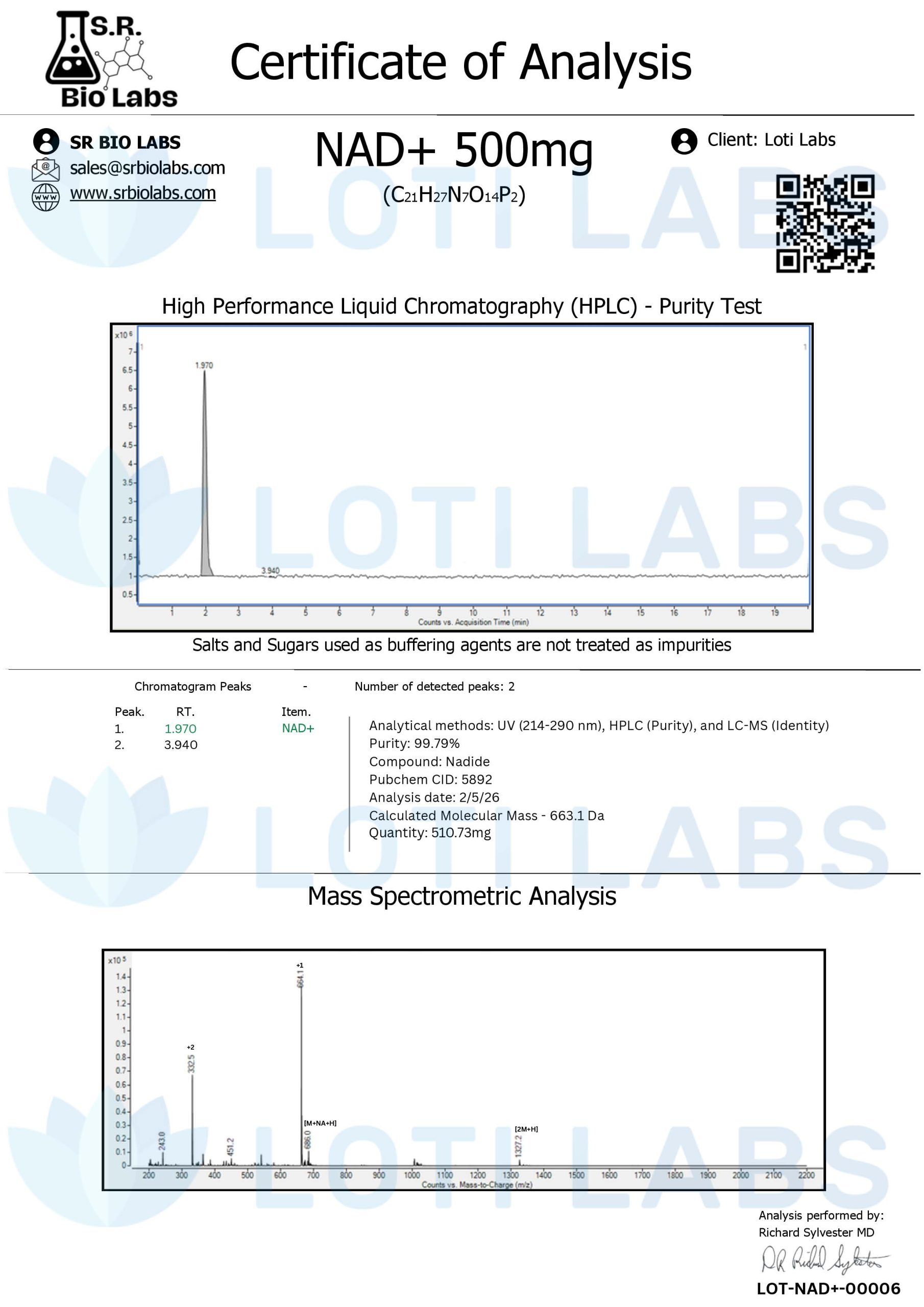
- HPLC Purity: Not specified in the supplied product data
- Solubility: Highly water-soluble
- Research Classification: Laboratory research compound
NAD+ Biosynthesis Research
Researchers investigate NAD+ biosynthesis through several established cellular pathways, including:
- De novo pathway: NAD+ synthesis from tryptophan
- Preiss-Handler pathway: NAD+ synthesis involving nicotinic acid
- Salvage pathway: Recycling of nicotinamide and related NAD+ metabolites
The interaction between NAD+ biosynthesis, cellular consumption and metabolic demand represents an important area of research in molecular biology and ageing-related laboratory models.
Storage & Laboratory Handling
The supplied product information describes NAD+ 500mg as a highly water-soluble lyophilised compound.
For laboratory handling:
- Store the lyophilised material at −20°C.
- Protect the compound from light and moisture.
- For aqueous laboratory preparations, use an appropriate sterile research-grade diluent or validated experimental medium.
- Prepare aqueous solutions as close to experimental use as practical.
- Avoid unnecessarily prolonged storage of aqueous preparations.
- Researchers should establish concentration, preparation and handling conditions according to their validated laboratory protocol.
- HPLC analysis may be used as an analytical method for purity verification of research preparations.
Mechanism of Action & Research Context
NAD+ Redox Function
One of the principal research functions of NAD+ is its participation in cellular redox reactions.
NAD+ 500mg acts as an electron acceptor during metabolic processes including:
- Glycolysis
- Tricarboxylic acid (TCA) cycle activity
- Fatty-acid oxidation
- Mitochondrial energy metabolism
During these reactions, NAD+ can be reduced to NADH, creating a dynamic redox system that researchers investigate in cellular energy and mitochondrial models.
Sirtuin Pathway Research
NAD+ 500mg also serves as a substrate for sirtuins (SIRT1–SIRT7), a family of NAD+-dependent deacylase enzymes.
Sirtuin research encompasses pathways associated with:
- Gene-expression regulation
- Cellular stress responses
- Mitochondrial function
- Metabolic signalling
- DNA maintenance
The relationship between NAD+ availability and sirtuin activity is consequently an important subject in preclinical research investigating cellular ageing and metabolic regulation.
PARP & DNA Repair Research
Poly(ADP-ribose) polymerases (PARPs) are another major class of NAD+-consuming enzymes.
PARP activity is investigated extensively in models of DNA damage and cellular stress. Researchers study how NAD+ 500mg availability interacts with PARP-mediated signalling and DNA repair processes.
This makes NAD+ relevant to laboratory investigations combining cellular metabolism, DNA damage response and genomic maintenance pathways.
CD38 & NAD+ Metabolism
CD38 is another important NAD+-consuming enzyme involved in NAD+ turnover and calcium-associated cellular signalling.
Research into CD38 provides an additional framework for investigating NAD+ metabolism, particularly in experimental models examining changes in NAD+ availability and cellular ageing.
Mitochondrial & Metabolic Research
NAD+ 500mg is extensively studied in mitochondrial research because of its central role in cellular redox balance and oxidative metabolism.
Preclinical research has investigated NAD+-related pathways in experimental models involving:
- Mitochondrial function
- Fatty-acid oxidation
- Glucose metabolism
- Cellular senescence
- Metabolic signalling
- Tissue and cellular stress responses
Research involving adipose cell culture studies can also examine NAD+-dependent metabolic pathways and their relationship with mitochondrial activity and cellular energy metabolism.
Comparative Longevity & Metabolic Research
NAD+ 500mg research is frequently conducted alongside other compounds and pathways associated with cellular ageing and metabolic biology.
Experimental research may investigate NAD+ alongside compounds such as Epitalon, GHK-Cu and 5-amino-1MQ to examine different molecular pathways associated with ageing biology, gene regulation and NAD+ metabolism.
These comparative approaches allow qualified researchers to investigate multiple cellular pathways within controlled in-vitro and preclinical research models.
Literature & Citation Index
The following scientific publications were supplied as references for NAD+ research:
- Yoshino J, et al. NAD+ intermediates: the biology and therapeutic potential of NMN and NR. Cell Metabolism. 2018;27(3):513–528.
- Cantó C, et al. The NAD+ precursor nicotinamide riboside enhances oxidative metabolism and protects against high-fat diet-induced obesity. Cell Metabolism. 2012;15(6):838–847.
- Imai SI, Guarente L. NAD+ and sirtuins in aging and disease. Trends in Cell Biology. 2014;24(8):464–471.
- Fang EF, et al. NAD+ replenishment improves lifespan and healthspan in ataxia telangiectasia models via mitophagy and DNA repair. Cell Metabolism. 2016;24(4):566–581.
Laboratory Terms & Compliance
LABORATORY RESEARCH USE ONLY
NAD+ 500mg is supplied strictly for qualified laboratory research, in-vitro testing, preclinical research, adipose cell culture studies and scientific experimentation.
This product is not intended for human or veterinary administration, consumption, diagnosis, treatment, prevention of disease, cosmetic use, therapeutic use, athletic performance or any other application outside qualified laboratory research.
Purchasers and researchers are responsible for ensuring that all handling, storage, testing and disposal procedures are conducted by appropriately qualified personnel and in accordance with applicable UK/EU legislation, institutional procedures and laboratory safety requirements.
No other uses are permitted.
You must be logged in to post a review.
Related products

Reviews
There are no reviews yet.